Your Gut Health Blueprint: 3-Zone Gut Testing Explained
Your Gut Health Blueprint: How 3-Zone Gut Testing Takes the Guesswork Out of Digestive Symptoms
A more personalized way to look at nutrient status, food reactivity, stool markers, and the bigger digestive picture.
Let’s get something straight: you can’t supplement your way out of confusion.
You’ve done the diets. Swapped the dairy. Tried the probiotics. Spent hours on Reddit and Instagram chasing the latest health hack, and still...
You’re bloated. Tired. Gassy. Constipated. Your skin is acting up and your energy won’t get past first gear.
At some point, trying one more random supplement stops feeling like a plan.
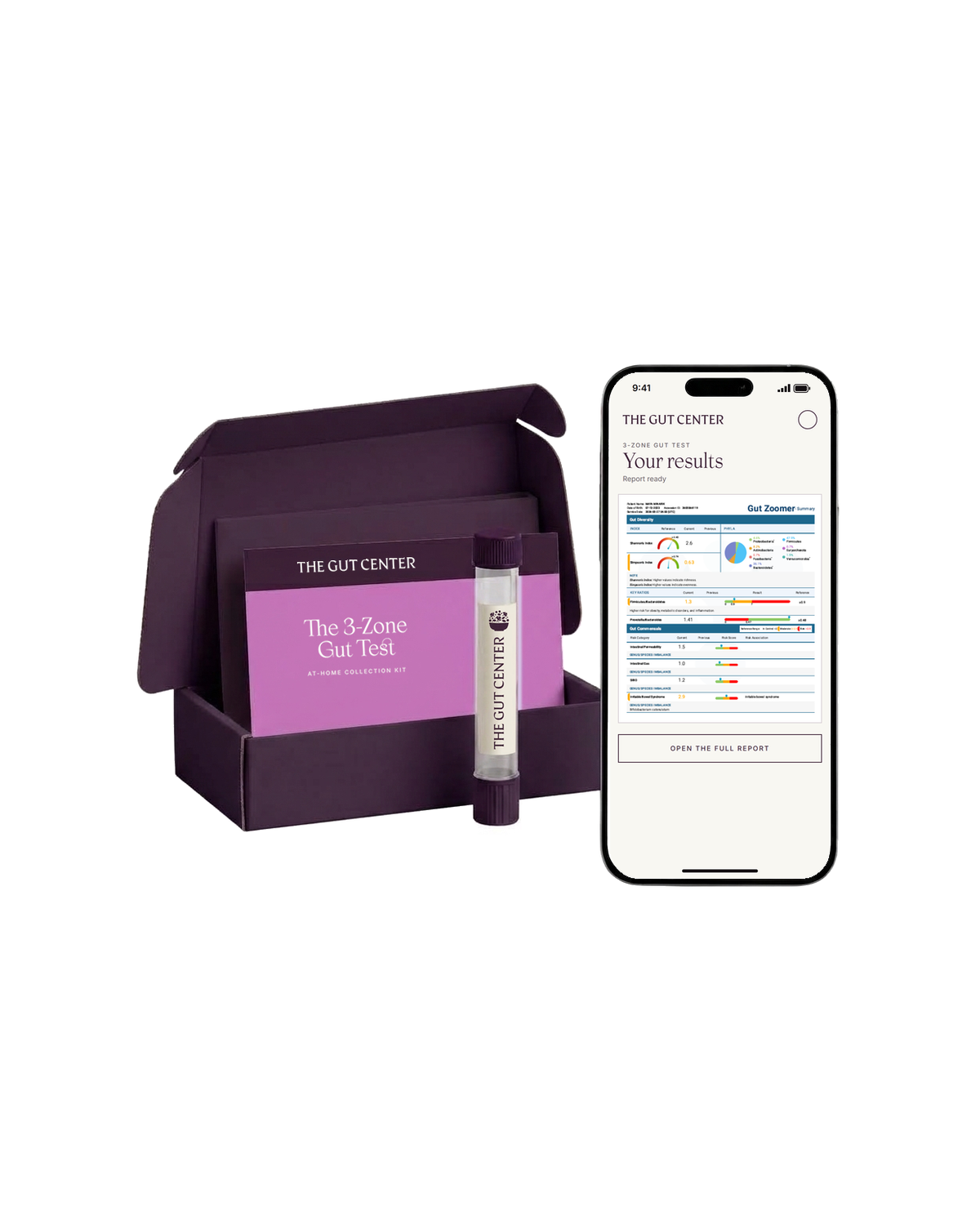
That is why we created The Gut Center’s 3-Zone Gut Testing approach: a combination of at-home testing designed to look at your digestive picture from multiple angles so we can move away from guessing and toward a more personalized plan.
Because your symptoms may be happening in the same body, but they do not always come from the same place.
Why One-Size-Fits-All Gut Health Plans Often Fall Short
If you’re frustrated, you have every right to be.
The wellness world is full of blanket advice:
- Take a probiotic.
- Cut gluten.
- Eat more fiber.
- Drink more water.
- Try digestive enzymes.
Sometimes those things help.
Sometimes they do absolutely nothing.
That is because digestive health is interconnected, and the same symptom can have more than one possible contributor.
Bloating can show up with constipation, food intolerance, IBS, altered fermentation, or changes in motility.
Low energy might make us think about nutrient status, food intake, sleep, stress, or absorption.
Food-related symptoms may require a completely different conversation.
It is not about running tests just to collect numbers.
It is about using information to ask better questions and build a more focused plan.
Why We Look at Three Zones Instead of Just One
Think of digestion like a long assembly line.
Food has to be broken down, nutrients have to be absorbed, and the lower digestive tract has to process and eliminate what remains.
If we only look at one part of that process, we may miss useful context from another.
That is the idea behind our 3-Zone approach.
We look at three different categories of information:
No single test explains everything happening in your digestive system.
But together, these results can give us a much more useful starting point than symptoms alone.
Zone 1: Micronutrient Testing
The first piece of the picture is your nutrient status.
Our micronutrient testing looks at a broad range of vitamins, minerals, amino acids, antioxidants, fatty acids, and metabolic markers.
Depending on the panel, this may include nutrients such as:
- Vitamins A, B vitamins, D, and K
- Zinc
- Magnesium
- Iron-related markers
- Copper
- Amino acids
- Glutathione-related markers
- Fatty acids
- Other metabolic markers
Why does this matter?
You can eat a beautiful diet and still have nutrient levels worth paying attention to.
A low or borderline result does not automatically tell us exactly why that nutrient is low.
Dietary intake, medications, supplementation, health conditions, increased needs, and digestion or absorption can all play a role.
But it gives us a concrete data point.
That helps make your nutrition and supplement plan more intentional.
Zone 2: Food Reactivity Testing
This is where we look at measured food-reactivity patterns across a wide range of foods and food-related compounds.
The panel may include common foods such as grains, fruits, proteins, oils, and other dietary components.
Why can this be helpful?
Food-related symptoms can be incredibly confusing.
You might eat the same breakfast three days in a row and feel completely different each time.
You may have already removed dairy, gluten, eggs, or other foods without knowing whether the restriction is actually helping.
Food reactivity testing can provide another layer of information to review alongside your symptoms and eating patterns.
Does a result line up with what you notice when you eat that food?
Is there a pattern worth exploring?
Would a short, structured removal and reintroduction give us more useful information?
Zone 3: Comprehensive Stool and Microbiome Testing
The third piece looks at what is happening in the lower digestive tract.
Depending on the specific stool panel, testing may include information about:
- Certain bacteria
- Parasites or other organisms
- Yeast-related findings
- Digestive function markers
- Inflammatory markers
- Pancreatic enzyme-related markers
- Microbial patterns
- Other stool-based digestive markers
Why does this matter?
Stool testing can provide a tremendous amount of information about certain aspects of the lower GI tract.
A stool test can help identify findings that would be difficult to infer from symptoms alone.
If you are bloated, for example, symptoms cannot tell us whether every person has the same microbial pattern.
If your digestion feels off, symptoms alone cannot tell us what a measured pancreatic or inflammatory marker looks like.
Testing gives us actual data to put next to the story your body is already telling us.
At the same time, we do not treat every microbiome finding as a diagnosis.
The microbiome is incredibly complex, and science is still learning what many individual patterns mean.
That is why interpretation matters.
Why We Put the Results Together
This is the most important part.
We do not want three separate reports sitting in your inbox.
We want to know what the information looks like together.
Maybe your nutrient testing identifies areas we want to support.
Maybe the food-reactivity panel highlights foods worth investigating rather than randomly removing.
Maybe the stool test gives us additional digestive or microbial information that helps explain why your symptoms have been so persistent.
That combined picture can help us decide:
- What deserves attention first
- Which foods may be worth experimenting with
- Which nutrients may need support
- Whether digestive support makes sense
- What habits may need to change
- Whether another type of testing or medical evaluation would be more appropriate
- Which supplements actually fit the plan instead of simply adding more
Who Is 3-Zone Gut Testing For?
Testing may be especially useful when you feel like you have already tried the basics and are still stuck.
You may want more information if you are dealing with persistent issues such as:
- Bloating
- Gas
- Constipation
- Diarrhea or inconsistent stools
- Recurring digestive discomfort
- Foods that seem unpredictable
- Low energy
- Nutrient concerns
- A long history of trial-and-error supplements
- Symptoms that keep returning despite changing your diet
It can also be useful for the person who says:
That does not mean every symptom automatically comes from the gut.
And it does not mean testing replaces appropriate medical care.
It means we have more information available when deciding what to explore next.
The Gut Center Approach: Data + the Whole Person
At The Gut Center, testing is not the entire protocol.
It is one part of how we understand the person in front of us.
We also look at things like:
- Your bowel patterns
- What and how you eat
- Hydration
- Stress
- Sleep
- Movement
- Symptoms around meals
- Medications and supplements
- Your health history
- What you have already tried
Then we use the testing to make that picture sharper.
This is where our Functional Ayurveda approach comes in.
We can honor traditional concepts around digestion, nourishment, rhythm, and elimination while also using modern testing to give us measurable information.
For us, the value is in using both thoughtfully.
Stop Guessing at Your Gut
If you have been bouncing from supplement to supplement, removing more foods, or trying a new gut protocol every month, you probably do not need more noise.
You need direction.
3-Zone Gut Testing gives us more information to work with so we can stop building your next step around assumptions and start building it around you.
The goal is not to find something “wrong” with every result.
The goal is to understand your digestive picture better, identify what deserves attention, and build a plan around you.
Gut Testing FAQs
What does The Gut Center’s 3-Zone Gut Testing include?
The 3-Zone approach combines micronutrient testing, food-reactivity testing, and comprehensive stool/microbiome testing so we can review several different aspects of digestive and nutritional health together.
Can gut testing tell me why I am bloated?
Testing can provide useful clues and measurable data, but bloating can have many causes. Test results are most useful when they are interpreted alongside your symptoms, bowel habits, diet, health history, and other relevant information.
Does the stool test diagnose SIBO?
No. SIBO involves the small intestine and is generally evaluated using other methods, such as hydrogen and methane breath testing when appropriate. Stool testing provides different information about the lower GI tract.
Is food reactivity testing the same as allergy testing?
No. A food-reactivity panel is not a substitute for medical food-allergy testing. We use food-reactivity findings as one piece of information alongside symptoms and food patterns rather than as a stand-alone diagnosis.
Can micronutrient testing show if I am absorbing nutrients?
It can show measured nutrient status. If a nutrient is low, digestion or absorption may be one factor to consider, but there are many other possible reasons. Results need to be interpreted in context.
Do I have to take supplements after testing?
No. Testing should help make recommendations more targeted, not automatically create a longer supplement list. Depending on your results, the most important next step may involve food, hydration, bowel regularity, lifestyle changes, targeted supplementation, or further evaluation.
Ready to Get Your Gut Health Blueprint?
If you are tired of trying to decode your symptoms on your own, 3-Zone Gut Testing can give us more data to work with and a clearer place to start.
Explore The Gut Center’s 3-Zone Gut Testing to see what is included and how we use the results to help build a more personalized gut-health plan.
Explore 3-Zone Gut Testing